
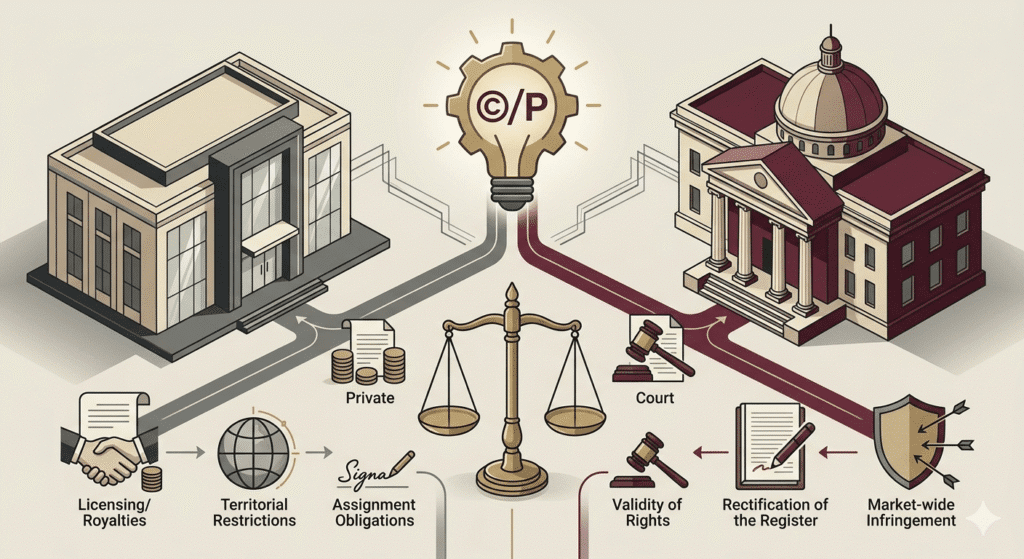
Arbitration now works for many IP disputes in India. But it cannot replace courts with big trademark and copyright fights that hit the public and the market. The real problem is drawing a clear line: private, contract-based IP issues can go to arbitration; classic infringement and validity questions should stay with courts.
Booz Allen v. SBI Home Finance, 2011 drew the key line that only rights in personam are generally arbitrable, while core rights in rem are not. For IP, this means validity/rectification issues stay with courts, but contract-based disputes over licensing, royalties or territories can be pushed into arbitration. IP rights themselves are in rem, but fights over how two parties use or share those rights, royalties, territory, and minimum guarantees are in personam and can be arbitrated.
Courts and commentators have made it clear: there is no blanket bar on arbitrating IP disputes. What matters is the kind of relief and whether a statute clearly reserves something for civil courts or specialised forums. A royalty quarrel under a copyright license is one thing; a pan-India injunction or trademark rectification is another.
A lot can already move to arbitration. License and assignment disputes are the obvious candidates: fights over royalty rates, marketing duties, territorial splits and termination have been treated as arbitrable rights in personam. Same with IP-heavy commercial contracts, franchise deals, co-branding, content syndication, and software integration, where the core issue is who breached the contract, not whether a mark or work exists.
Cross-border IP agreements follow this logic even more. High-value tech-transfer and content deals now routinely choose World Intellectual Property Organisation, Singapore International Arbitration Centre or International Chamber of Commerce regulations for arbitration with Indian law as governing law, especially after India’s “IP powerhouse” narrative in WIPI 2025. For these parties, arbitration’s confidentiality, speed and expert tribunals are more attractive than years of High Court litigation.
But there is a hard stop on core infringement and validity. Questions about validity, subsistence, or ownership of registered rights, cancellation, rectification, or disputes that really attack the existence of copyright have an erga omnes impact and are tied to public registers. Arbitrators cannot bind non-parties or change the register, so that work stays with courts and specialised bodies.
Statutory remedies matter too. The Trademarks Act and Copyright Act bundle civil damages with criminal penalties, customs measures and other public-law-flavoured tools that private tribunals simply cannot grant. And third-party interests are not a minor point: a trademark injunction can reshape entire markets, hurt parallel importers and affect consumers who are nowhere near the arbitration clause. That kind of structural effect needs a public forum, not a private room.
So, where does policy push us? Towards more IP arbitration, but only at the “private” edge.
Filings and IP disputes are climbing; High Courts are flooded with interim relief applications, portfolio fights and routine royalty disputes. Shunting the purely inter-party stuff, franchise revenue, production deals, and messy audits, into arbitration frees courts for questions that actually need a public decision.
For platforms, gaming studios and global brands, speed and cross-border enforceability are not theory; they are survival issues. An emergency arbitrator order plus New York Convention enforcement can be commercially sharper than a domestic decree that takes months to bite. Confidentiality also helps in sensitive content or endorsement disputes where reputations and trade secrets are on the line.
Comparative practice goes even further. Some systems let arbitrators touch infringement and validity, as long as awards are filtered through IP offices before registers change. Scholarship keeps suggesting that India could adopt a similar model with safeguards for public interest.
For now, Indian writing and recent case law lean towards a middle path. Keeping courts for validity, subsistence and rectification; pure infringement or passing off with market-wide and third-party impact; and using arbitration for license, assignment fall-outs, distribution and co-production agreements, royalty quantum, audit fights, field-of-use and territory conflicts and termination issues.
Some practical ways to help forge the base are-
- Drafting split clauses, for example, in trademark/copyright contracts, separate “pure contract” disputes (to arbitration) from “register/infringement” disputes (to courts) in the dispute resolution clause.
- Hard-code urgency for streaming, gaming, or brand deals, including emergency arbitration plus carve-outs for approaching courts for status-quo orders when third-party harm is likely.
- Plan for registers if an award might touch ownership/validity, build in a step for court confirmation and register updates, instead of pretending the tribunal can bind the entire world.
- Use institutions, not ad hoc, for MSMEs and creators, institutional rules (MCIA, WIPO, SIAC) with capped fees and fast-track procedures are more predictable than ad hoc arbitration bolted onto a boilerplate clause.
In short, courts should guard the public face of IP, and arbitration should clean up the private mess behind it. The trick to it is writing your clauses as if that line already exists.
References
- https://indiankanoon.org/doc/188958994
- https://www.indiacode.nic.in/handle/123456789/1978
- https://ipindia.gov.in/writereaddata/Portal/IPOAct/1_43_1_trade-marks-act.pdf
- https://copyright.gov.in/Documents/CopyrightRules1957.pdf
- https://www.wipo.int/amc/en/arbitration/rules/
- https://siac.org.sg/our-rules/siac-rules-2016
- https://iccwbo.org/dispute-resolution/dispute-resolution-services/arbitration/rules-procedure/2021-arbitration-rules/