Semiconductor Patents and the Battle for Technological Supremacy
Abstract
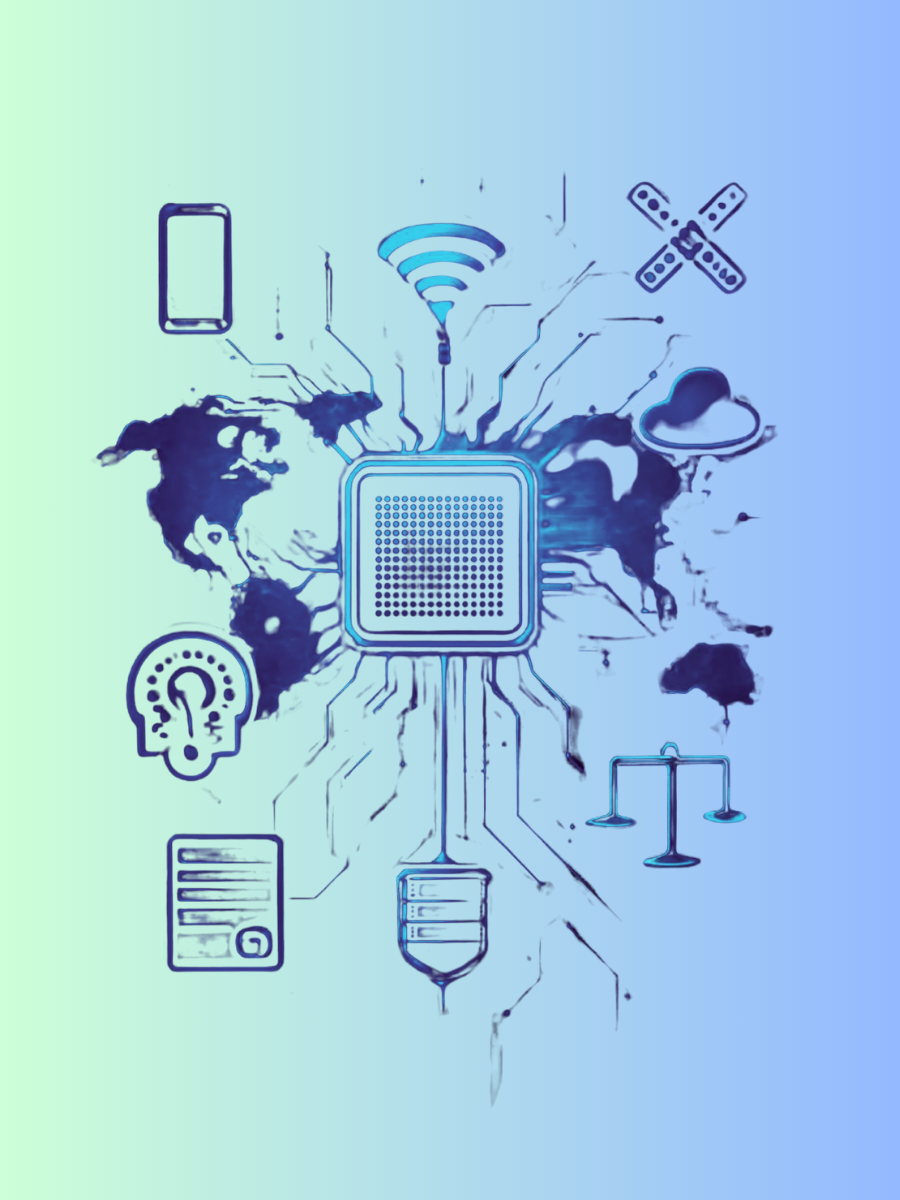
We have seen how semiconductors have gone from a component of electronics to a tool for international political dispute, an economic keystone and the ground on which some of the biggest modern intellectual property disputes are fought. The licensing might of QUALCOMM in its earlier days, the ongoing dispute over ARM/NVIDIA; none the less without any significant publicity the semiconductors sphere has developed into a playing field where the contest of patents determines not only the battle between competitors, but the movement of goods and services, national security. The purpose of this blog will be to discuss how intellectual property law, more specifically patent law, is the center of chip wars around the globe.
Introduction
Whenever we discuss the continued conflict between the US and China about semiconductors, our discussions always turn to issues like trade sanctions, export controls, or which company is building what kind of facility in which part of the world. We never get around to discussing the more low-key, yet just as important, struggle taking place within patent offices, arbitration panels, and courts of law worldwide.
Semiconductors themselves are merely substances-generally silicon-which can transmit electric current under specific conditions. However, what is placed upon this material: the design of the circuit, the technique by which the chips are manufactured, the structure of the chips themselves, all are covered by intricate webs of intellectual property rights. Since even one processor may contain thousands of different patented inventions, it is easy to see why the law concerning patents has become at least as important as the engineering that produces the chips.
Patent law was designed to encourage innovation by granting temporary monopolies to inventors. In theory, patent law was set up as a system to incentivize innovation by granting inventors a temporary monopoly. This is a fair bargain in principle. In the realm of semiconductors, however, it has become a complex mess of patent thickets, royalty conflicts, and licensing litigation which often benefits antitrust lawyers more than the engineers who make the chips.
The Patent Thicket Problem
What constitutes a ‘patent thicket’ is defined as “a series of intertwined and overlapping patent rights that a company must obtain licenses for, or purchase or use through licensing” in order to bring a product to market.The semiconductors industry is no exception to this; it is rather the norm. Companies such as Qualcomm, InterDigital, and ARM have large portfolio’s that stretch over thousands of patents, covering everything from wireless communications standards to the design of chip architecture.
The difficulty in this comes when these patents become a barrier rather than an incentive. The practices of Qualcomm are a clear indication of this. The firm has long demanded licensing of standard essential patents (SEPs – patents that cover technologies used in industry standardisation) at what both customers and competitors say are abusive rates. Apple and Qualcomm endured a prolonged court battle that traversed many countries before a resolution was reached in 2019. The US Federal Trade Commission (FTC) brought a case against Qualcomm as well, initially ruling that its “no license, no chips” policy constituted anti-competitive behaviour.
What this means is from a legal perspective is the conflict between intellectual property rights and competition law is ever present within the industry. The Designs Act, the Patents Act and their foreign equivalents were not written taking into account the ‘patent wars’ in semiconductors. The courts are still developing where the boundaries of ‘legitimate IP monetisation’ lay, and when such a strategy becomes an ‘abuse of dominance’.
Architecture Wars: ARM, NVIDIA, and the Question of Control
The failed acquisition attempt of chip design giant ARM Holdings by NVIDIA in 2020 perhaps best encapsulates what is at stake for semiconductor IP. In many ways, ARM is the invisible infrastructure powering all of modern computation: its chip designs power nearly every smartphone in the world and increasingly data centers and AI hardware. NVIDIA’s $40 billion bid was withdrawn in 2022 following the objections of regulators in the U.K., the European Union and the U.S. The fear was simple: should NVIDIA, a leading chip maker and ARM’s largest customer, come to own ARM’s IP it would acquire enormous leverage over all of ARM’s other licensees-in effect, over all the other companies in the mobile chip market. It highlighted a significant risk in our digital ecosystem: control of foundational sector-wide IP can be, as well as competitive advantage, a chokepoint. It is a new kind of control that antitrust regulators worldwide are now starting to grapple with as a threat comparable to market share control in other industries.
India in the Semiconductor IP Landscape
Where is India’s role in all of this? Honestly, the picture is still being built and, to some extent, that’s as much of an opportunity as it is a deficit.
The Patents Act, 1970 in India has traditionally been quite wary of software and process patents, and this position has solidified following the 2013 Novartis v. Union of India case upholding the restrictions imposed on evergreening by Section 3(d). While this has benefited Indian pharmaceutical companies, the dynamics in the semiconductor sector are different: chip design is fundamentally about hardware architecture and manufacturing processes, areas that lend themselves more easily to, and are, for this reason, more critical for the attraction of investment, to patentability.
The push from the Indian government, by way of the Semicon India Programme (which provides incentives for domestic manufacturing and design of chips) is a welcome one. However, setting up a semiconductor ecosystem involves much more than factories and subsidies-it requires the establishment of an IP infrastructure to go with it. Foreign companies will invest only when confident that their IP will be enforceable swiftly and reliably. Our courts, although doing better, still have a lot of backlogs. Though setting up of dedicated IP divisions in High Courts is good news, efficiency remains a real worry.
Conclusion
This phenomenon in the semiconductor space is an illustration of the arguments that have long been debated in legal theory, but which are now playing out in the pages of the popular press. IP is not simply a private dispute between an inventor and a rival: IP forms industries, is a tool of geostrategy, and will be central to which nation’s engineers and companies will drive the next generation of technological innovation. The Chip War is the legal scholar’s reminder that IP law is a living, evolving sphere, not a fixed body of rules. Patent thickets, patent holdout, and M&A as a mechanism for IP aggregation- these issues strain the capacity of current legal doctrines. It falls to the next generation of IP lawyers to not only know the law as it is, but to craft the law that ought to be; nowhere is that need more evident than in the chip arena. As more of the world’s infrastructure operates on semiconductors, understanding their legal framework will be as important to the lawyers who study them as their physical construction is to their engineers.
References
World Intellectual Property Organization, ‘Intellectual Property and Frontier Technologies: Semiconductors’ (WIPO Technology Trends, 2022) <https://www.wipo.int/tech_trends/en/semiconductors/> accessed 20 May 2025.
Carl Shapiro, ‘Navigating the Patent Thicket: Cross Licenses, Patent Pools, and Standard Setting’ in Adam B Jaffe, Josh Lerner and Scott Stern (eds), Innovation Policy and the Economy, Vol 1 (MIT Press 2001) 119, 120.
Qualcomm Inc, Annual Report 2023 (Qualcomm Incorporated 2023); see also InterDigital Inc, ‘Patent Licensing’ <https://www.interdigital.com> accessed 19 May 2025.
Apple Inc v Qualcomm Inc, Case No 3:17-cv-00108-GPC-MDD (SD Cal), Settlement announced 16 April 2019.
Federal Trade Commission v Qualcomm Inc, 411 F Supp 3d 658 (ND Cal 2019); reversed in part, 969 F 3d 974 (9th Cir 2020).
NVIDIA Corporation, ‘NVIDIA and SoftBank Group Announce Termination of NVIDIA’s Acquisition of Arm Limited’ (Press Release, 8 February 2022) <https://nvidianews.nvidia.com> accessed 18 May 2025.
Novartis AG v Union of India (2013) 6 SCC 1 (Supreme Court of India); Patents Act 1970, s 3(d).
Ministry of Electronics and Information Technology, ‘Semicon India Programme’ (Government of India, 2022) <https://semiconductors.india.gov.in> accessed 20 May 2025.