Introduction
Memes have become the language of social media and have developed rapidly thanks to the young generation in recent years. Expansion has been such that even in the elections, political parties are fighting with constant attacking trolls and memes, social movements are gaining traction through memes, and everyday emotional expression is increasingly taking meme form. A single image from a film or a cute kitty picture can be transformed into hundreds of variations featuring different emotions through morphs and other means within hours, each carrying a new meaning that reflects collective social consciousness.
Despite such presence, memes continue to exist upon a shaky legal foundation. Memes use, mostly, copyrighted images, clips, or artworks without proper authorisation. Thus, thinking rationally, it would appear meme culture’s existence itself is a paradox in the face where IP laws are gaining momentum day by day. Yet memes persist, thriving in a space where law, social norms, and technological practice intersect.
So, who owns a meme? This question matters now because copyright enforcement has become automated, platform-driven, and increasingly aggressive. As expense moderations systems are beyond the human touch of understanding humour, parody, caricature, irony or context. As memes begin to generate advertising revenue and political influence, copyright owners and platforms have greater incentives to intervene. The legal ambiguity surrounding memes is no longer academic. It directly affects freedom of expression, social engagement and participation, and the future shape of online creativity platforms.
Background
A meme is commonly defined as an amusing or interesting item (such as a captioned picture or video) or genre of items that is spread widely online especially through social media under Merriam Webster Dictionary. Memes, in essence, are micro-parodies embedded in everyday discourse.
Copyright as Control Over Expression
Copyright law aims to incentivise the creators of original creative works by granting them exclusive rights over their works, including reproduction and adaptation. The reasoning is very simple i.e., without sufficient legal protection, creators would lack motivation, both financial and mental, to create. Although this seems to fit reasonably well with books, films, and music albums, memes do not fit this model. A meme is not viewed or used as a replacement for the original work. A screenshot from a Bollywood film used to joke about Monday mornings does not diminish the value of the film. Instead, it creates a new layer of meaning that exists independently of the original narrative.
Originality and Derivative Use
Indian copyright law protects originality of an authored work. The “originality” term has been understood as to work having “flavour of minimum amount of creativity” after the landmark Supreme Court case of Eastern Book Company v. D.B. Modak, rather than mere labour. This framework is challenged and complicated by memes. This is due to the reason that a meme creator may contribute originality through selection, captioning, and context, but the work upon what such meme is being built upon remains protected.
Copyright law traditionally treats such works as derivative and derivative works generally require permission. This doctrinal rigidity creates friction when applied to internet culture, where derivation is the norm rather than the exception.
Fair Dealing Under Indian Law
The Indian counterpart of US Copyright Law 17 U.S. Code § 107 is provided under section 52 of the Act, which lays down an exhaustive list of exceptions for fair dealing, including criticism, review, and reporting of current events. However, unlike US “fair use”, Indian law does not provide an open-ended balancing test. Memes can be seen as criticism or parody, but Indian courts have not yet explicitly addressed this question. The absence of judicial guidance still forces meme creators to rely on assumptions rather than legal certainty.
Main Discussion
Memes as Transformative Expression: An Analogy
The Indian legal precedent for satire is in its primitive stage but has already provided strong defense for meme creators. In cases dealing with copyright exceptions, Indian courts tend to focus on the work’s purpose, beyond the form of the work. If the purpose is genuine criticism, commentary, or the creation of a new, distinct work of humor, the courts generally are inclined to favor the free flow of ideas over the rigid protection of copyright adhering to the constitutional guarantees of free speech under Article 19(1)(a). The key distinction lies in intent: a meme intended to comment on society or policy, even if using a protected visual, maintains a high chance of being deemed fair dealing, whereas a meme used strictly for commercial gain or to misrepresent the original work’s creator would likely fail the test.
In a way, an analogy can be drawn by taking an example of language itself. Just like, words are not owned by anyone, yet they are borrowed, reshaped, and reused endlessly, a meme functions similarly, except it uses visual language rather than verbal language. The protected image or base is the vocabulary and the caption and context are the literary works.
Consider a widely circulated meme using a still from the film 3 Idiots, where the character of Raju appears frustrated conveying academic pressure within a specific storyline. The meme version may use the same still to comment on office culture, government bureaucracy, or exam anxiety- a hundred of things.
This transformation is central. The meme does not invite viewers to experience the original film. It invites them to recognise the image and reinterpret it. This aligns closely with the idea of transformative use recognised in Campbell v. Acuff-Rose Music, where parody was held to add new meaning rather than merely replicate the original.
Although Indian courts have not explicitly adopted the transformation doctrine, Civic Chandran v. Ammini Amma is an stark example of judicial willingness to tolerate critical reworking of copyrighted material.
Market Harm: A Practical Illustration
Imagine a meme page that posts a single frame from that film with a humorous caption. No rational consumer believes they have “consumed” the film by viewing the meme. There is no substitution effect as such and thus, Copyright law’s economic justification is weakened significantly in this case. Memes are social commentaries and really do not function as competing products. In some cases, they even revive interest in older works, introducing them to new audiences. Indian courts have considered market impact in educational and informational contexts, even if not systematically. In The Chancellor, Masters & Scholars of the University of Oxford v. Rameshwari Photocopy Services (Delhi University Photocopy case), the Delhi High Court explicitly rejected the argument that educational photocopying necessarily causes market harm, prioritising access to education over speculative loss to publishers. Only if this logic could be extended to memes as well, copyright doctrine will meet economic reality.
Selective Enforcement and the Street Law of the Internet
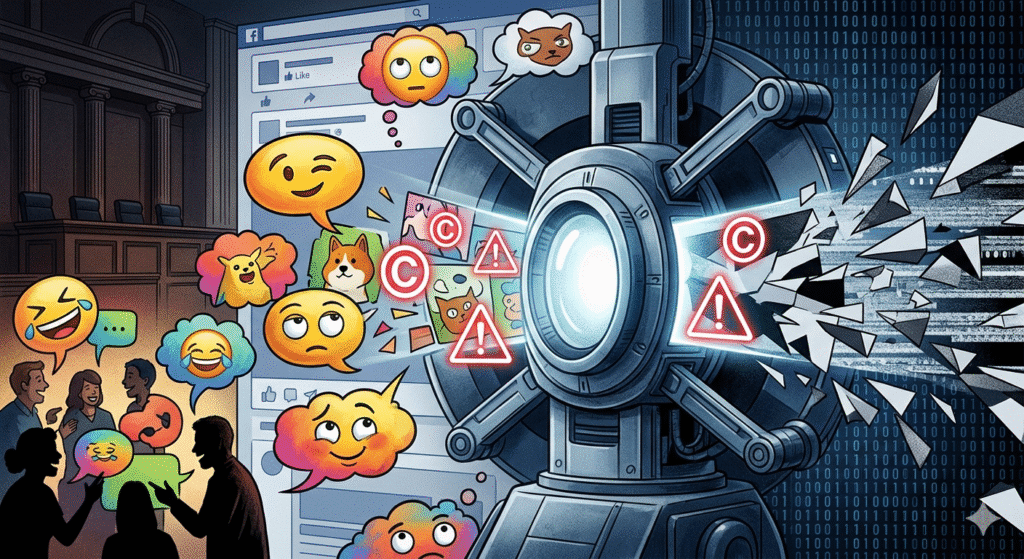
The rise of Content ID and similar algorithmic enforcement systems represents the greatest practical threat to meme culture. These systems operate on fingerprinting technology, identifying identical or near-identical portions of media but lacking the capacity for semantic analysis. Processing the contextual transformation i.e., the irony, the commentary, or the parody that makes a meme is. Consequently, automated takedowns often misidentify legitimate fair dealing uses as infringement, creating a “Chilling Effect” on creativity. This outsourcing of judicial function to private platforms and algorithms results in a system where the default position is suppression, forcing creators to prove their innocence after the fact, a burden particularly heavy for non-commercial, individual users.
The lived reality of meme culture resembles “street law” more than statutory law. Copyright owners generally tolerate memes unless three red flags appear: monetisation, political controversy, or reputational harm.
For example, a meme mocking a politician using a movie still is rarely challenged by the film studio. However, if the same meme is used in a sponsored political campaign, takedowns become more likely. This distinction is not found in the statute but rather is enforced informally through platform community guidelines and manipulation through financial inputs. Automated takedown systems worsen this problem as algorithms cannot distinguish between parody and piracy, explained above. A meme may be removed not because it is unlawful, but because it resembles copyrighted content. This places expressive freedom at the mercy of technical systems rather than legal principles.
Memes and Collective Authorship: A Thought Experiment
In reality, a meme template evolves over time i.e., one person uploads an image, another adds text, a third changes the context, hundreds of users modify it further. Who is the author then?
Copyright legislation struggles with this question because it assumes identifiable creators. Loosely it can be said, memes resemble folklore more than authored works. No one owns a proverb, yet everyone uses it. Memes function as digital proverbs, reflecting shared experiences rather than individual genius. If copyright law insists on tracing ownership at every stage, it risks criminalising ordinary cultural participation. This outcome would contradict copyright’s broader objective of promoting creativity and free speech and expression.
Indian Context: Silence as Legal Problem
India has a rich tradition of satire, parody, and visual commentary, from socio-political cartoons to street theatre and nukad natak. Memes are simply the digital continuation of this tradition. Yet Indian copyright jurisprudence has not engaged meaningfully with this evolution much. The absence of case law creates unpredictability. Meme creators rely on assumptions about tolerance rather than rights. Platforms act as de facto regulators without accountability. This legal silence effectively shifts power away from courts and towards private actors.
Conclusion
Memes continue to test the limits of copyright law’s traditional assumptions. They rely on copying but create new meaning; they use protected works but do not replace them; they are collectively produced yet legally unrecognised, per se. The question of who owns a meme is ultimately a question about the future of creativity. If copyright law remains rigid, it risks suppressing an entire mode of cultural expression. If it evolves thoughtfully, recognising transformation, absence of market harm, and collective creativity, it can remain relevant in the digital age.
To resolve this systemic ambiguity, copyright law must accommodate specific ‘Digital Remix and Commentary’ exceptions, tailored to the realities of online communication. Such an exception would prioritize works that are non-commercial and transformative, regardless of whether they fit the pre-defined categories of criticism or review. Another possible way could be the endorsement or active adoption of the principles of the US Transformative Use doctrine, making market substitution the primary determinant of infringement, a factor where memes almost universally succeed in their defense. Without a proactive doctrinal shift, the legal system risks falling further behind technological and cultural evolution, relegating a major form of contemporary expression to a legally precarious, tolerated status.
References
- Financial Express Bangladesh, “How Memes Have Become the Youth’s Language” (Lifestyle), available at: https://thefinancialexpress.com.bd/lifestyle/how-memes-have-become-the-youths-language
- Medianama, “YouTube Content Takedowns Under Indian Law: A Growing Concern” (June 2025), available at: https://www.medianama.com/2025/06/223-youtube-content-takedowns-indian-law/
- Merriam-Webster Dictionary, “Definition of ‘Meme’,” available at: https://www.merriam-webster.com/dictionary/meme
- Internet Freedom Foundation, “Striking Silence: How YouTube’s Broken Copyright System Threatens Free Speech,” available at: https://internetfreedom.in/striking-silence-how-youtubes-broken-copyright-system-threatens-free-speech/
- Aiplex Anti-Piracy, “YouTube Copyright Policy: Why Aiplex Sends Copyright Strikes to Users,” available at: https://www.aiplexantipiracy.com/blog/youtube-copyright-policy-why-aiplex-sends-copyright-strike-to-users
- The Copyright Act, 1957, s. 14 (India).
- Mondaq, “Copyright Law and Internet Memes in India,” available at: https://www.mondaq.com/india/copyright/1258894/copyright-law-internet-memes
- Eastern Book Company v. D.B. Modak, (2008) 1 SCC 1 (Supreme Court of India).
- 17 U.S.C. § 107 (United States).
- The Copyright Act, 1957, s. 52 (India).
- Constitution of India, art. 19(1)(a).
- Campbell v. Acuff-Rose Music, Inc., 510 U.S. 569 (1994).
- Civic Chandran v. Ammini Amma, 1996 (16) PTC 329 (Kerala High Court).
- The Chancellor, Masters & Scholars of the University of Oxford v. Rameshwari Photocopy Services, (2016) 160 DRJ 584 (Delhi High Court).
- SSRN, “Digital Speech, Copyright Enforcement and Platform Power,” available at: https://papers.ssrn.com/sol3/papers.cfm?abstract_id=5367971
- ACM Digital Library, “Algorithmic Moderation, Copyright Enforcement and Platform Governance,” available at: https://dl.acm.org/doi/pdf/10.1145/3610095
- SAGE Journals, “Memes, Political Expression and Participatory Culture,” Journalism & Mass Communication Quarterly, available at: https://journals.sagepub.com/doi/10.1177/1077699020950492
- Lawrence Lessig, Free Culture: How Big Media Uses Technology and the Law to Lock Down Culture and Control Creativity (Penguin Press, 2004), available at: https://www.researchgate.net/publication/28802969_Free_Culture
- Justia, “Transformative Use and Copyright Infringement Lawsuits,” Justia Intellectual Property Law Center, available at: https://www.justia.com/intellectual-property/copyright/fair-use/transformative-use/