
What the Amul Girl Teaches Us About Brand Evolution and Legal Protection
Introduction: When Logos Won’t Stay Still
Logos also won’t stay still, according to the Introduction. No one ever complained of any brand confusion when Google changed its logo to a Doodle celebrating a local poet’s birthday. Consumer awareness of the product was not lost when the Coca-Cola Company’s red ribbon turned into the mask created for social distancing during the COVID-19 pandemic.
Then every Tuesday morning, millions of Indians wake up to an Amul girl, who, overnight, has become a commentary on the latest news in the nation. See welcome to the age of the fluid trademark, one which intentionally, strategically and consistently morphs how it looks without losing any of its essence.
This is the great paradox of which all IP practitioners and brand managers must be aware; Trademark law is a doctrine of consistency. Registration systems will give rewards for stability. In the beginning, distinctiveness is developed by repetition. In a world that’s as responsive, meme-fuelled and attention-starved as digital marketing, however, the brands that change, adapt and surprise succeed. Can Indian IP law safeguard a mark that’s not moving?
Well, the answer is a in the affirmatives “yes” and it’s important to read the fine print in the law if you’re going to use it.
Fluidity as a Brand Strategy – Amul Girl Masterclass
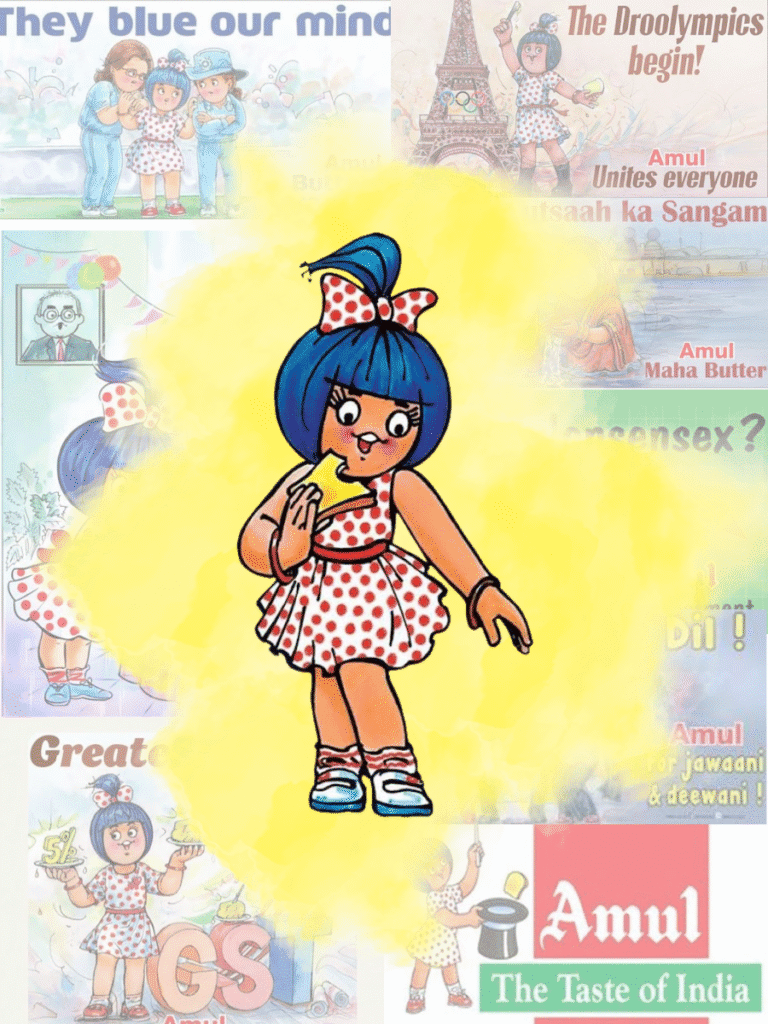
To understand the notion of fluid trademark in India, all you need to do is take a look at a butter wrapper. That happy, round, pink and blue-eyed child in her red polka-dotted dress, and unique blue hair that has been the most agile brand mascot in India since 1966.
She is the creation of cartoonist Eustace Fernandes and late Sylvester daCunha; she has been seen commenting on various cricket scandals, political upheavals, Bollywood releases and the world’s pandemics. Her illustrations are updated every week. Her context is always unique. But no one gets her mixed up with anyone else. Here’s the business savvy that lives inside of a seamless trademark campaign the visual elements shift, the brand constants don’t. Amul’s legal and creative team knows, and, no doubt, feels what brand experts refer to as the invariant core
The blue hair (as it was in the 1960s), The red dress with a large number of polka-dots is an instant visual hallmark of the costume. The face is round, warm, familiar and unthreatening, cherubic in appearance. The Amul brand name and its unique typography form the basis of all versions of the wordmark. Each repetition of the Amul wordmark is anchored by the Amul and its unique typography. The context of the illustration, which could be about the IPL, could shift to a joke about an AI chatbot, but the identity remains intact. From a brand strategy point of view, it’s genius. From an IP perspective, it is precisely this invariant core that determines whether fluid marks receive legal protection.
What the Trade Marks Act, 1999 doesn’t say
There isn’t a single mention of fluid or series-of-visual trademarks in the dynamic sense in the Indian Trade Marks Act, 1999. The closest statutory tool is Section 15 which allows the registration of a chain of trademarks, that are identical or similar in material particulars and just have different non-distinctive elements. In theory, a brand could have a number of different variations of its logo registered as a series.
In practice; Section 15 has become too slow and ill-suited to modern fluid campaigns. Considering Each variation has to be examined under Section 15 to be registered Protection takes months sometimes years to be granted for the process.
An Amul cartoon which comments on the Supreme Court’s verdict on this topic shouldn’t wait for 18 months to get trademarked. Digital campaigns have a different news cycle, running on 48-hour news cycles, while the Trade Marks Registry have a completely different one.
This creates a huge legal lacuna; while the Amul does dozens of fluid variants every year, most of them are unregistered and are commercially utilised. This is NOT negligence… ? it is structural inevitability. Then where do they get their protection?
Procter & Gamble v. Joy Creators (2011)
The judgment of Delhi High Court in the case of Procter & Gamble Home Products Ltd. v. Joy Creators & Anr. (2011) was not a case involving a fluid trademark fact pattern, but nonetheless, pronounced a doctrine of tremendous consequence to the issue that was at the heart of this case. The situation in question was that of a bigger company like P&G having its name used in a smaller company’s product that P&G allegedly did not approve of.
Defendant contended that since the original was not exactly duplicated there was no infringement or passing off, The Delhi High Court was not convinced by this argument and dismissed it The Court concluded that the plaintiff does not need to prove that its mark is an exact duplication of the defendant’s mark. It is enough to show that the defendant’s mark is similar to a “substantial degree” because defendant adopted the “main features” of plaintiff’s mark this is the doctrine which counts.
This is the doctrine that matters.
- “Main features” not the entire mark, but its identifying core elements
- “Substantial degree” a qualitative, not pixel-perfect, standard of resemblance
- “Extensive use” the protection grows proportionally with how deeply those features are embedded in consumer consciousness
By trademarking its blue hair, polka dots, recognizable face, and wordmark for decades and for many years making it a part of their consumer consciousness, Amul has pretty much secured its trademark. Amul’s trademark is the blue hair, polka dots, recognizable face, and wordmark, and if those core features are trademarked by Amul over decades of use, and their trademark becomes a part of many consumers’ consciousness, then any other party that uses those core features infringes, even if they use a completely different illustration around them. But Amul’s own fluid variations, which keep those key features but alter other details fall within the umbrella of the same mark. The P&G decision has effectively given fluid trademarks their most valuable legal protection, namely, that of passing off based on the non-fluid or non-perishable part, the “core of the mark”. A brand does NOT have to register each iteration, it should, on the other hand, vigorously defend and delineate its base characteristics by persistent and documented use.
The Double-Edged Sword: Why Fluidity is a Privilege, not a Right is available on Amazon.
A big warning is in order before each start-up starts redesigning its logo every fortnight, as a rule, fluid trademarks are the hallmark of established trademarks. Here is why: Distinctiveness requires repetition. The consistency in exposure by consumers is the way a mark becomes legally strong. A brand that flatters its logo too often and too much never gives consumers a chance to create a solid association, which is the crux of trademark protection. Genericide risk if the features of a mark are too general or vague, then it may become entirely unidentifiable. Courts might conclude that the mark has become too broad to serve as a source identifier. The P&G doctrine is a double-blown one. Whereas it is difficult to establish a main feature, the main features cannot be invoked because a copycat can claim that the “original” mark was not sufficiently stable to warrant protection. The Amul Girl has been able to enjoy the level of fluidity because six decades of the same core features have given birth to a well-known trademark one that enjoys the highest level of protection under Section 11(6) of the Trade Marks Act. At the launch time of the company, that runway is simply not there.
Conclusion
“At last we need to construct the Fort before opening the Gates” The Indian treatment of fluid trademarks is a tale of judicial creativity where there is a lack of legislative provisions. The P&G v. Joy Creators doctrine provides a reasonable guideline but it’s up to the brand to do its homework.
- Register the invariant core first. Before any fluid campaign, ensure the base mark logo, mascot features, wordmark, colour combinations is registered and documented.
- Document use obsessively. In passing off actions, evidence of prior and extensive use is everything. Maintain timestamped records of every fluid variation published.
- Section 15 has limited utility for rapid campaigns use it for planned variation series, not for reactive social media content.
- The P&G standard protects the soul, not the skin. Courts will protect your main features even when variations surround them but only if those features are distinctively yours.
- Fluidity is a growth-stage strategy, not a launch strategy. Earn your trademark equity first; evolve it second.
For six decades, the Amul Girl has been an integral part of Indian consciousness, so much so that she can don any topical costume and walk home as Amul. It’s not simply a great marketing tactic.
References
Procter & Gamble Home Products Ltd. v. Joy Creators & Anr., Delhi High Court, 2011 Indian Kanoon: indiankanoon.org
The Trade Marks Act, 1999 (No. 47 of 1999), Government of India, Section 11(6) — Well-Known Trademark definition, Section 15 — Registration of Series of Trademarks, Available at: indiacode.nic.in
The Trade Marks Rules, 2017 — Procedural rules governing registration, including series marks