
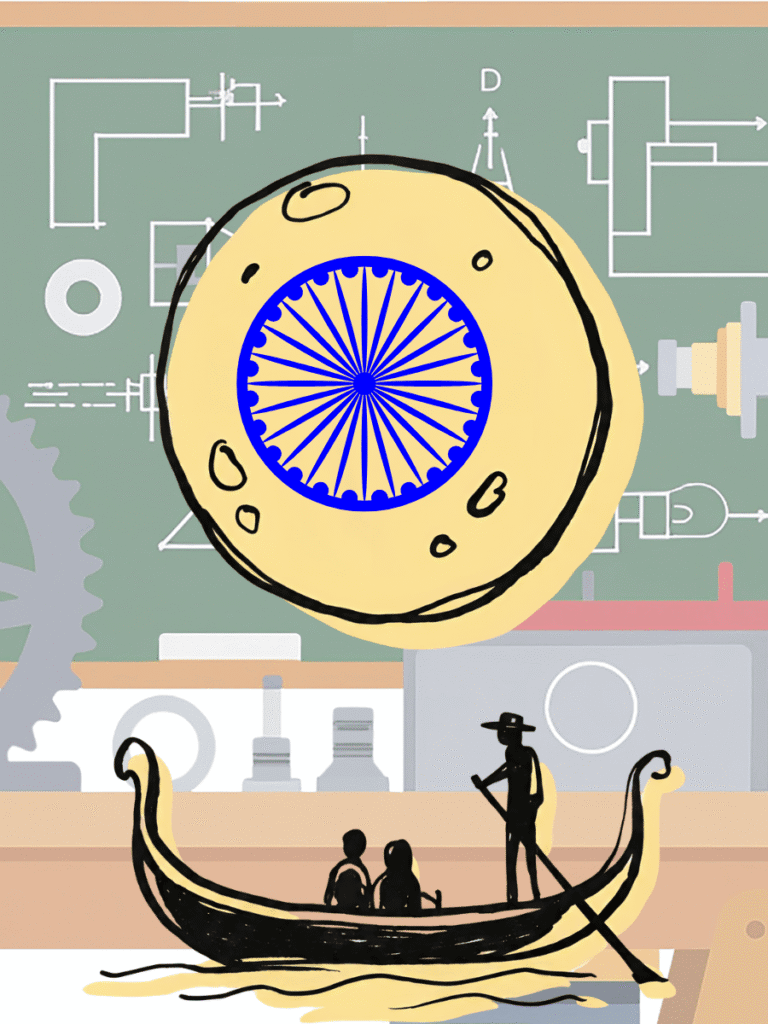
JOURNEY OF INTELLECTUAL PROPERTY RIGHTS
Abstract
Every day, we go through many art works, art forms and new inventions. Everyone uses it in different ways. Using it is not an offence, but copying it and making profits out of it is..! This blog explores the journey of Intellectual Property rights and laws from Venice to India, that is from the 1474. It also discusses a case law in relation with the AI and IPR. Read deep into the blog and know more.
Introduction
From 1474…!
The concepts of Intellectual Property rights and laws were born in Venice. The Venetian Statute of 1474, was the first formal system, which was intended to protect the inventors, which was way before Vasco Da Gama arrived in India!
This statute established the core principles of Novelty, Utility and Term. Novelty means, whatever the invention is, it must be new. Utility refers to the usefulness to the state and Term states that, the protection given to a particular invention would last for 10 years. During the 15th century, ‘Brain drain’ was a major issue, for Venice. People in Venice wanted to make, The Venice city one of the richest city in the world. For that, they introduced many strategies, and the statute was one among them. They were telling their inventors “If you bring your secret to our city, we will make you rich, and protect you from copycats.”, this was their idea for building their economy.
Why the Intellectual Property Rights?
Have you ever thought for the dismissal of the Intellectual property laws? The majoritarian answer would be ‘NO’, right? The IP rights are rooted in the principles of economics and social ‘bargains’, where a monopoly is given to a person for a certain period of time and the person may produce a progress to the society. There is a maxim, “Nemo Debet Locupletari Ex Aliena Jactura”, which means that ‘No person should grow rich out of another person’s loss’. And this principle can be used for the intellectual property rights, as it protects the inventors. If there is no restrictions or laws, it can give rise to the ‘Free rider’ problem, this occurs when people consume or misuse freely available resources or services, and starts making profit out of someone else’s inventions.
Story of India
The story of Indian Intellectual Property rights began back in the mid19th century, during the British rule, but the critical changes or the ‘evolution’ occurred after the Indian Independence. In India, the first Patent law was the Act VI of 1856, based on the British Patent Law, 1852. George DePenning got the first patent for the ‘Efficient Punkah Pulling Machine, in Calcutta. Later, laws were introduced for trade marks and designs called the Indian Patents and Designs Act, 1911, used in India for nearly 60 years. After Independence, the people realized that, the patents act and other acts introduced by the Britishers were for their own benefits, for which Justice N. Rajagopala Ayyankar commission was formed for analysis and studying, and later Indian acts came into force, like the Patents Act, 1970 and others.
Unlike the Venetian Statute of 1474, which was about attracting talents to the city and making it rich, Indian Intellectual Property laws were about social justice. The laws protect the people’s interest and we can relate it to the “Nemo Debet Locupletari Ex Aliena Jactura”, which I mentioned earlier. As per the section 3(d) of the Patents Act, 1970, a patent is given only for a certain period of 20 years, inventors cannot claim re issuing it under any other provisions. This section act as a stopper to the concept of ‘evergreening’.
AI and rights
Have you ever thought of writing a story using AI tools like the ChatGPT, Gemini, Claude or any such tools? Actually, you don’t have to fear, like Oh, Can I do? The answer is, yes, you can, but the thing is, you cannot claim any copyrights for this act, that is, a work done by an AI cannot be stated as yours. In the case of Thaler v. Perlmutter, the court of Columbia stated that, inventions made with AI cannot be accepted for the Copyrights, under the Copyright Act, 1976 and similarly, the U. S. court of Appeals for the Federal court held that, inventions or any such act by an AI, cannot be given Patent, so he was denied the patent rights. Yeah, in this era of Artificial Intelligence, everyone uses it, so how can someone give a special right?
Conclusion
The journey of Intellectual Property is not about building or setting high goals, or creating a monopoly, but it’s about creating and protecting rights. From Venice to Indian corners, the journey was not so easy, every journey has its own struggles and obstacles. Those who overcome such obstacles will stay. Intellectual property rights and laws were introduced for the purpose of protecting the socio – economic interests of the inventions, who made it with efforts. When people, who worked day and night are not getting the profits and someone else is growing rich out of it, Is that fair? I don’t think so. So, introduction and implementation of Intellectual Property Rights gives them a helping hand to grow, and protect them from being it stolen. But these rights are not absolute, they are only valid for a certain period of time. So, thus it avoids a monopoly. Through this blog, I tried to cover the maximum and know how to use and when to use.
References
LawBhoomi, ‘Intellectual Property Rights Notes’, (11 April 2026), [Intellectual Property Rights Notes]
The Patents Act, 1970
National Bureau of Economic Research, ‘THE DIFFUSION OF NEW INSTITUTIONS: EVIDENCE FROM RENAISSANCE VENICE’S PATENT SYSTEM’, (December 2017), [The Diffusion of New Institutions: Evidence from Renaissance Venice’s Patent System]
Carlton Fields, ‘No Copyright Protection for AI-Assisted Creations: Thaler v. Perlmutter’, (26 March 2025), [No Copyright Protection for AI-Assisted Creations: Thaler v. Perlmutter | Carlton Fields]
LawBhoomi, “Nemo Debet Locupletari Ex Aliena Jactura”, (24 July 2024), [Nemo Debet Locupletari Ex Aliena Jactura]