
Introduction
India has large deposits of rare earth elements, and the monazite sands in the state of Odisha are important for its plans to generate nuclear power. China’s dominance over the market poses a risk in the form of cheap imports that affect the country’s miners. A Geographical Indication for the monazite from Odisha would establish its distinctions, increase its market value, and improve the national security aspects as proposed in the Sustainable Harnessing and Advancement of Nuclear Energy for Transforming India (SHANTI) Bill, 2025.
Unique Features of Odisha Monazite
Monazite is one of the essential phosphate minerals that contains significant levels of rare earth elements such as cerium, lanthanum, neodymium, and thorium. Some of India’s richest monazite deposits are found along the beaches of Odisha, including Ganjam, Puri, and around Chilka Lake. These are a part of India’s 13.15 million tonnes of in-situ reserves of monazite. Indian Rare Earths Limited (IREL) processes 4,000 tonnes of this annually at its “Odisha Sands Complex” (OSCOM) facility, located at Chatrapur, to produce “thorium oxide, which will be utilised to fuel ‘Generation III’ nuclear reactors.”
What sets Odisha monazite apart? It contains higher levels of thorium traces, estimated at up to 10%, due to sediment from the Mahandi River delta. This contrasts with other states like Kerala or Tamil Nadu.
And for how long have local people been using these materials? They have been using them for many years in their pottery-making industry. Presently, these materials are mixed with inferior imported materials due to a lack of GI protection.
Importance in Nuclear Supply Chains
The Sustainable Harnessing and Advancement of Nuclear Energy for Transforming India (SHANTI) Bill, 2025, is an improvement over outdated statutes such as the Atomic Energy Act, 1962. It permits cooperation with the involvement of the government regarding uranium and thorium deposits. Odisha monazite is contributing to Stages II & III of the nuclear program of India, aiming for a total of 100 GW by 2047.
Supply chains are even weaker. India imports refined RE for use in EVs, defence equipment, and solar energy. Initiatives such as the National Critical Mineral Mission (NCMM) 2025 and the production-linked incentive scheme (PLI) are helpful, but these are insufficient. If China reduces exports, as witnessed in 2025, prices may soar by 50-100%. OSCOM is operating short of its installed capacity because of green and coastal restrictions, impacting the production of Monazite.
GI tags introduced under the 1999 Geographical Indications Act relate quality to geographical origin, as with Darjeeling Tea or Basmati Rice. For monazite, quality assurance through lab analysis for thorium levels and the use of blockchain technology shall ensure quality. This aligns with SHANTI’s efforts on undertaking nuclear projects by the private sector. IREL can supply assured monazite to those constructing Small Modular Reactors. Local organisations may thus earn an additional 20-40% and achieve the goal of 25,000 tonnes of Rare Earth Oxides by 2035.
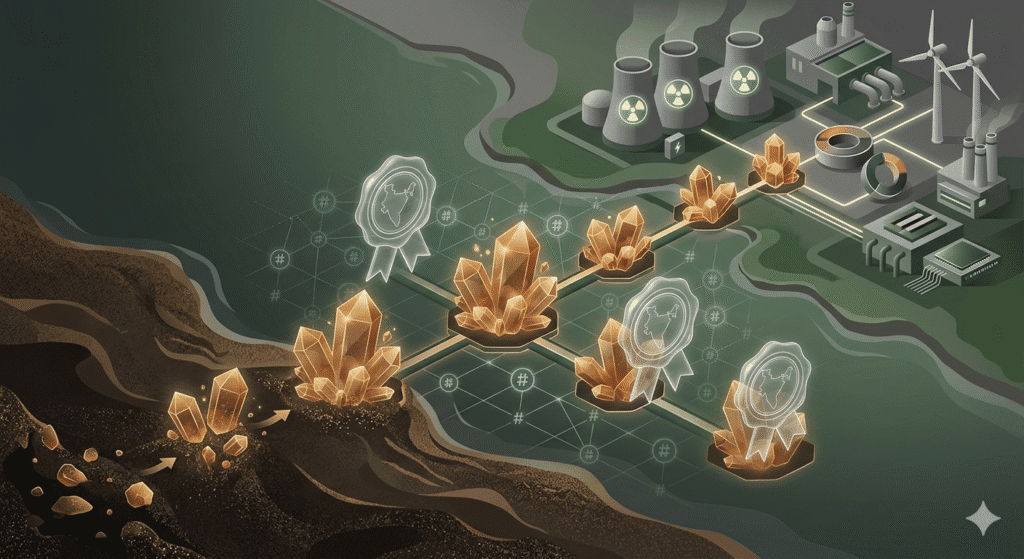
Consider the chain:
Monazite from Odisha’s beaches is processed by OSCOM. Rare oxides are supplied to producers of GI magnets that power reactor turbines. GI takes care that each step has actual Odisha material instead of imitation imports.
IPR Innovation: Blockchain for GI Traceability
A whole new perspective can be found in combining IPR intellectual property rights tools and nuclear requirements, and that is through blockchain-supported GI identifiers for monazite materials. “Conventional GIs are based on paper certificate systems, and what can be achieved is a first-of-its-kind innovation of setting up smart contracts based on blockchain technology to ensure that not a single speck of fuel gets wasted from the time it reaches the shore to being utilised at the nuclear reactor,” the bill sums up. Every lot will have a “digital twin”.
It aptly defeats Chinese counterfeits. Nobody can counterfeit a blockchain journal legitimised by IREL and GSI nodes for imported items. Smart contracts auto-transfer funds solely after scans for purity.
Do we have precedents for this? Yes, blockchain projects for Darjeeling Teas are exported. For nuclear chains, this guarantees that non-governmental organisations in SHANTI obtain tamper-resistant materials, reducing disputes by a whopping 70% for global pilots.
Challenges from Chinese Imports
China’s plan is evident: to cheaply acquire the markets through overproduction and then restrict the market. Their export restrictions in 2025 were a blow during the global peaks in demand. In Odisha, the Chinese “monazite sands” import comes through an intermediary country, hurting local markets and employment opportunities for fishermen.
A GI tag alters this position. It exclusively reserves the right to use the trademark. Violation attracts fines of up to ₹5 lakhs or imprisonment under Section 20 of the GI Act, 2000. Trials have shown that authentication for proven sources, such as the protection of genuine turmeric, is legal. The 8-12% ThO2 content of Odisha monazite, as assessed, will verify the incorrectness of imports.
GI also encourages “green practices.” Regulations may reduce beach excavation, damaging olive ridleys, a species of turtle. It will reduce the generation of radioactive waste, such as in 2019, Ganjam healthcare woes due to leakage. There is an “obligation to safeguard natural resources.” Expansion to 2,000 tonnes a year may produce “5,000 additional employment opportunities.” Smaller enterprises in the area will produce “neodymium-praseodymium oxide” magnets in the nuclear power or EV sectors.
It not only provides employment but also enhances skills. The workers are trained in processing technology, making India less dependent on foreign experts. It also helps in Atmanirbhar Bharat with critical minerals.
Legal Process and Needed Changes
Acquisition of a GI requires less effort, yet some arduous work is involved. The Odisha state Minerals Department applies to the Chennai GI Registry Office. Evidence of reputation associated with a territory requires information obtained from the Geological Survey of India (GSI) and the Atomic Minerals Directorate (AMD). These include 50-year records at IREL, soil analysis, and user experiences. A three-month window allows for objections to be raised.
Even so, there are a few obstacles that need to be cleared. The Patents Act omits atomic inventions, but the GI includes raw minerals at this point. SHANTI classifies deposits under government control, but GI permits states, including Odisha, to market their products. Solutions might involve: GI and auctions of mines under the Mines Act. NCMM could finance local facilities.
In international relations, the WTO/TRIPS agreement supports GIs. India can use free trade agreements to promote “rare earth” standards. Other countries, such as Australia, are testing “monazite” GIs for exported products.
Real Benefits and Steps Forward
GI tags have done wonders in the past. The sales of Rasagola in Odisha have increased by 300% since it was accorded a GI tag. The same can be achieved for “Ganjam Monazite Sands.”
For communities, train women self-help groups (SHGs) to ensure quality. Revenues could be utilised for purchasing clean mining equipment, transforming old pollution areas into an employment centre. Imagine coastal areas with units for processing, health-safe, and export-quality.
Why It Matters Now
With the opening up of nuclear power by SHANTI, the need for assured availability is paramount. Odisha monazite is more than just sand; it is fuel for clean energy, magnets for defence, and employment for millions. Imports by the Chinese are threatening to blow away their advantage.
India’s thorium advantage can fuel the world if it’s safeguarded carefully. Untapped resources are just waiting, but time is running out in the global race to harness this clean technology.
Conclusion
GI tags for Odisha monazite can strengthen nuclear supply chains by ensuring authenticity, traceability and strategic mineral security. Linking GI tags for Odisha monazite with blockchain verification supports Atmanirbhar Bharat and reduces dependence on Chinese imports. Such GI protection aligns intellectual property with energy security and critical mineral governance.
References
- https://www.pib.gov.in/PressReleasePage.aspx?PRID=1883492
- https://knnindia.co.in/news/newsdetails/global/india-discovers-85-mn-tonnes-of-rare-earth-elements-amid-global-supply-concerns
- https://www.academia.edu/70768440/Geochemistry_of_the_Heavy_Mineral_Sands_from_the_Garampeta_to_the_Markandi_beach_southern_coas
- https://www.drishtiias.com/daily-updates/daily-news-analysis/shanti-bill-2025
- https://chemindigest.com/indias-rare-earth-remains-untapped-amid-chinas-dominance/
- https://timesofindia.indiatimes.com/city/hyderabad/blockchain-tech-helped-tandur-tur-dal-bag-gi-tag/articleshow/96266618.cms
- https://science.thewire.in/health/monazite-mining-badaputti-chronic-kidney-disease-thorium/
- https://en.wikipedia.org/wiki/IREL_(India)
- https://ibm.gov.in/writereaddata/files/17125771666613da8e2e6a6Rare_Earths_2022.pdf
- https://prsindia.org/billtrack/the-sustainable-harnessing-and-advancementof-nuclear-energy-for-transforming-india-bill-2025