
INTRODUCTION
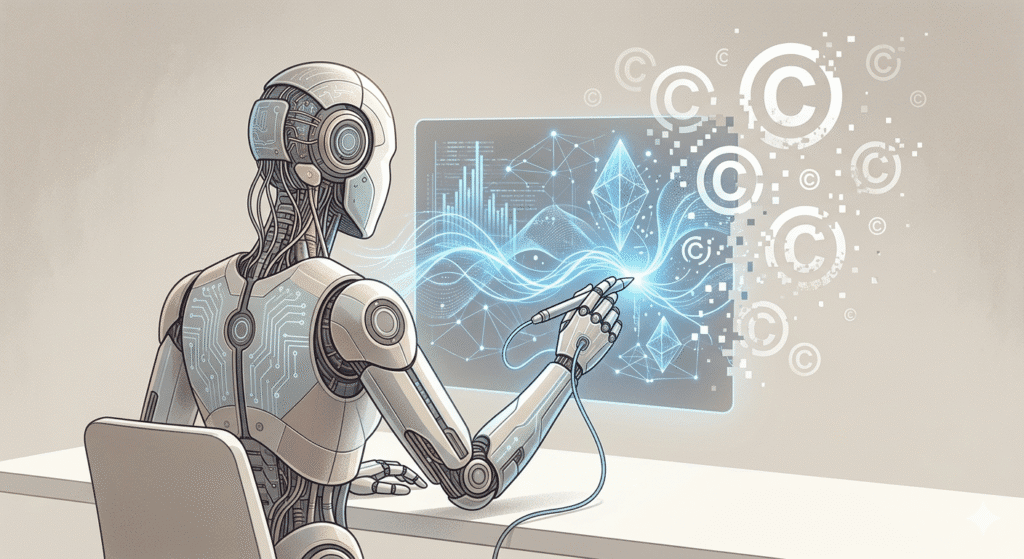
Copyright law was built on an assumption so basic that it rarely needed to be stated: creative works come from people. The law protects books because someone wrote them, paintings because someone painted them, and music because someone composed it. Technology has always been involved, but it has traditionally played a supporting role. Cameras did not replace photographers; word processors did not replace writers. Artificial intelligence unsettles this balance. It does not merely assist creativity; it increasingly performs it.
What makes this shift difficult to process is not the quality of AI-generated output. Much of it is competent, some of it impressive, and a small portion indistinguishable from human work. The difficulty lies elsewhere. Copyright law is not concerned only with what is produced, but with how and by whom it is produced. When those questions lack clear answers, the structure of the law begins to wobble.
ORIGINALITY AND THE WEIGHT OF HUMAN JUDGMENT
Originality is the gatekeeper of copyright protection. Indian courts have repeatedly emphasised that originality is not synonymous with novelty. It’s about making creative choices. In Eastern Book Company v. D. B. Modak, the Supreme Court ruled that mechanical labour and pure effort were not enough to protect something. Instead, they stated that a small amount of creativity, based on human intelligence, was required.
This insistence matters. It ties copyright to the judgment, rather than the result. A work is protected not by its existence, but by the discretion exercised in its creation. This logic becomes even more complicated with the introduction of artificial intelligence. An AI system can produce outputs that no human has previously conceived, yet the process that generates them does not involve deliberation in the legal context. There is no weighing of alternatives, no intention to communicate a particular idea, no moment of authorship as the law understands it.
Calling such outputs ‘original’ stretches the concept to its breaking point. They may be new, but they are new in a way that copyright doctrine has never been designed to recognise.
AUTHORSHIP WITHOUT A HUMAN ANCHOR
If originality opens the door to protection, authorship determines who walks through it. The Copyright Act, 1957, defines the term ‘author’ across various categories of works, but the definitions share a common feature: they all presuppose human agency. Even where ownership vests in corporations or employers, the creative act itself is ultimately attributed to an individual.
Artificial intelligence disrupts this chain. When a machine generates work autonomously, authorship becomes a game of attribution rather than recognition. Programmers build systems but do not control specific outputs. Attempting to fit AI-generated works into these categories feels less like interpretation and more like improvisation. Copyright law begins to answer questions it was never intended to ask, using concepts that were never meant to be stretched this far.
JUDICIAL RELUCTANCE BEYOND INDIA
Courts in other jurisdictions have shown little appetite for such improvisation. In the United States, the Ninth Circuit’s decision in Naruto v Slater reaffirmed that copyright protection is confined to human authors, even when a work is undeniably expressive. The case involved a monkey rather than an algorithm, but the reasoning has proved durable: authorship is a legal status reserved for humans.
This position has been reinforced administratively. The US Copyright Office has refused to register works generated entirely by AI systems without meaningful human involvement, drawing a clear line between assistance and substitution. Similar instincts can be seen in patent law, where courts have resisted recognising AI systems as inventors.
These decisions share a common tone. They do not deny the sophistication of machines. They deny that sophistication alone is enough.
APPROACHING THE TRAINING DATA QUESTION
Even before the question of protection arises, AI-generated works carry a quieter complication. They are not created in isolation. Their existence depends on prior works, books, images, music, and text that are absorbed during the training process. This raises questions that copyright law has not yet confronted directly, particularly within the Indian framework.
What matters is not only who creates, but what creation is built upon. At this point, copyright law begins to confront the foundations of AI creativity itself.
MARKETS, INCENTIVES, AND CREATIVE SATURATION
Copyright law has always been defended on economic grounds. The standard story is familiar: grant exclusive rights, and creators will have a reason to create. That logic becomes unstable when creativity is no longer scarce. Artificial intelligence can generate content continuously, without fatigue, and without the opportunity cost that shapes human decision-making. The issue is not simply that machines are faster. It is that they change the economics of creative labour itself.
If AI-generated works are granted the same protection as human-authored works, copyright risks becoming detached from effort altogether. Exclusive rights would attach not to creative investment, but to ownership of computational infrastructure. A handful of entities with access to powerful models could dominate cultural markets, not because their works are better, but because they are abundant. In such a landscape, copyright would cease to function as an incentive and begin to resemble a barrier to innovation.
At the same time, denying protection entirely is not a neutral choice. AI-generated content is already widely circulated in advertising, design, entertainment, and publishing. These outputs generate value, and that value will be captured by someone. The absence of copyright does not eliminate markets; it simply alters who controls them. The question, then, is not whether incentives will exist, but whether they will align with the original purpose of copyright law.
What makes this moment difficult is that copyright was never meant to regulate volume. It was designed to reward creative judgment. When production becomes limitless, the law struggles to distinguish between expression and output.
THE INDIAN CONTEXT AND LEGISLATIVE QUIET
This tension is occurring in India, where the government is not commenting on it. The Copyright Act of 1957 was written for a world where authors could be easily identified, and creative processes could be tracked. Even the changes made to it later were meant to improve digital distribution, not autonomous creation. As it stands, the law doesn’t say whether works made by AI should be protected, given limited recognition, or not at all.
This silence forces courts into an awkward position. Any attempt to recognise AI-generated works through interpretation risks diluting settled principles of authorship and originality. Any refusal to do so leaves commercially valuable content outside the formal legal framework. Neither outcome is entirely satisfactory, but courts are institutionally constrained. They can interpret law; they cannot redesign it.
The longer the reform is delayed, the more uneven the outcomes are likely to become. Different benches may resolve similar disputes differently, depending on how strictly they adhere to human-centric doctrines. For creators and businesses alike, uncertainty becomes the norm rather than the exception.
RETHINKING PROTECTION WITHOUT REDEFINING CREATIVITY
One way to respond is not to give in to the urge to stretch copyright to cover every new type of production. Copyright has always set limits on aspects such as ideas and expression, originality and imitation, and protected works versus the public domain. There may need to be another such boundary for artificial intelligence. Taking AI-generated works as automatically protected risks away from the idea of authorship. Ignoring the economic realities of modern creative industries and treating them as completely unregulated risks. Between these two extremes lies a more nuanced approach: protecting human creativity without pretending that machines create things in the same way people do. This could mean that some important outputs are not protected, or that protection is based on human involvement instead of machine output. It may also mean realising that not all new ideas need to be protected by exclusive rights to grow.
CONCLUSION
Artificial intelligence poses not only a technical challenge for copyright law, but also exposes its philosophical limits. A legal framework built on human creativity now confronts creativity without intention, personality, or consciousness. Indian copyright law, with its emphasis on human intellectual effort, has little room for such works, and that may be by design rather than defect.
The real threat is not that AI-generated works won’t be protected, but that people will forget the purpose of copyright altogether. If the law starts to reward production that doesn’t involve judgment, it could become indifferent to creativity itself. As machines continue to generate a vast amount of content, copyright law doesn’t need to keep pace with technology; it needs to determine which values are worth preserving.
REFERENCES
Cases
- Eastern Book Company v D B Modak (2008) 1 SCC 1.
- Naruto v Slater 888 F.3d 418 (9th Cir 2018).
Statutes
- Copyright Act 1957 (India).
- Copyright, Designs and Patents Act 1988 (UK), s 9(3).
Policy & Institutional Materials
- World Intellectual Property Organization (WIPO), Revised Issues Paper on Intellectual Property Policy and Artificial Intelligence (2020).
- US Copyright Office, Zarya of the Dawn Registration Decision (2022).
Academic Scholarship
- Pamela Samuelson, ‘Allocating Ownership Rights in Computer-Generated Works’ (1985) 47 University of Pittsburgh Law Review 1185.
- Jane C Ginsburg, ‘People Not Machines: Authorship and What It Means in the Berne Convention’ (2018) 49 IIC 131.