
Why That GI Tag on Your Darjeeling Tea Doesn’t Help the Farmer Who Grew It
I’ve been reading through GI case studies for weeks now, and something keeps bothering me. Everyone talks about Pochampally Ikat as if it’s a success story, wages increased by 20%, and demand rose by 15-20% after 2004. Which is great. Genuinely. But here’s what nobody asks: where did the rest of the money go?
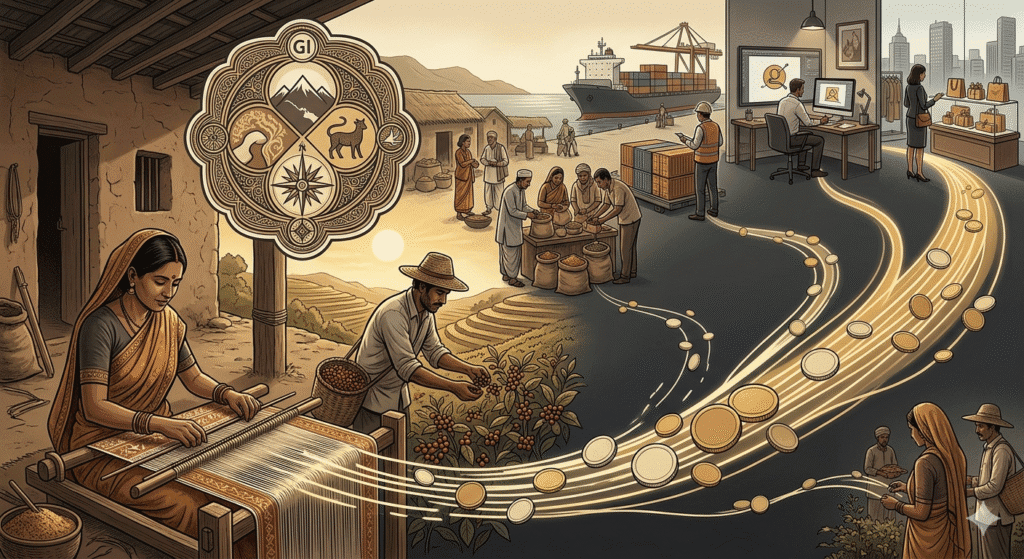
Here’s the thing about GIs that doesn’t make it into policy documents: A weaver’s wage going up 20% doesn’t mean 20% more profit made it to the loom. It usually means the consumer paid 50-60% more for that fabric, but somewhere in between, in distribution, marketing, or warehousing, people who never touched a thread kept most of the profit.
We’re taught that intellectual property protects creators. But GIs are weird. They don’t really protect individuals. They protect a place. And places don’t spend money or make decisions. People do. And some people, usually not the ones actually making the thing, are much better at capturing value from a protected place than others.
The Application Nightmare Nobody Talks About
Let’s be honest about what happens when a farmer in Warangal or a weaver in Pochampally wants their product registered as a GI. They need to hire a lawyer. They need to gather documents proving their region’s traditional methods. They need to prove quality standards. They need to, this is the kicker- get the entire community to agree and file collectively.
That last part is important. The GI Act doesn’t let individuals register. It’s collective by design. Which sounds inclusive. In practice, it means that one person with resources and connections usually ends up coordinating the entire process. And that person? Often a trader. A middleman. Someone who already profits from these products.
I found this in that Aishwarya Sandeep article. Chikankari craftspeople in Lucknow have a GI. Firozabad glassware has a GI. Both have “faced significant difficulties in preserving the unique crafts and providing economic benefits to the artisans.” Not because GIs don’t work, but because the people who actually run the registrations aren’t always the ones holding the needle or the glass.
The framework assumes that if you protect the name, the money follows. But it doesn’t. The money follows power. And the people with the most power in GI registration are usually not the most skilled at the actual craft.
The Counterfeiting Joke
Okay, so you’ve got your GI. Darjeeling tea is protected. Basmati rice is protected. Alphonso mangoes are protected. Theoretically, someone selling fake Darjeeling from some other region should be stopped, right?
Except, enforcement requires resources. You need to monitor markets. You need to catch infringement. You need to sue. For a farmer or a cooperative of weavers making maybe 15,000-20,000 rupees a month, hiring a lawyer to fight counterfeiting is just not going to happen.
The infrastructure for enforcement doesn’t exist at the scale where it’s needed. The IP Office doesn’t have field agents. Regional authorities do not consistently monitor sellers. And by the time someone notices counterfeit Darjeeling or fake Pochampally Ikat in the market, months have passed. The damage is done. The counterfeiter has already made their profit and moved on.
So what actually happens? Large exporters and companies with their own legal teams protect GIs. They can afford the lawyers. They can afford the monitoring. Small producers can’t. So the protection mechanism, in reality, protects the large players, the aggregators and exporters, much more than it protects the actual makers.
The Economic Disparity That’s Baked In
Here’s the uncomfortable part. The GI framework was designed in a world where producers are already organised. Where they have capital. Where legal processes are familiar. It was transplanted into India, where most artisans are illiterate, where communities are scattered across villages, where language is a barrier, and where cash flow is monthly, not annual.
The Chikankari example keeps coming back to me. Registration didn’t automatically fix anything because registration isn’t the problem. The problem is that Chikankari artisans in Lucknow compete against mass-manufactured, embroidered fabrics from China and fast-fashion companies that can undercut prices. The GI doesn’t help with that. It just says ‘you’re allowed to call your thing by this name’. It doesn’t build distribution networks. It doesn’t teach the artisan to market globally. It doesn’t provide them with the capital to scale production or upgrade equipment.
The GI tag is like earning a diploma that says you’re qualified, but nobody actually wants to hire you because you lack industry contacts, a strong resume, or a well-developed networking strategy. You’re qualified on paper. That’s it.
Who Actually Benefits?
The people who benefit most from GI registration are the ones who can afford to take advantage of it: traders, exporters, established brands, companies with export departments. They use the GI as a quality signal in international markets. They build their brand around it. They capture the premium.
The artisan? They get word-of-mouth support and maybe a slight wage increase if the trader decides to pass some of the premium down. That’s not protection. That’s hope.
This is what the framework misses. It assumes geography creates value. Actually, geography just means you have the right to a name. The value gets created by everyone else downstream—the packager, the marketer, the distributor, the person telling the consumer why this product is special.
The Real Issue
The real issue with GIs in India isn’t the law. It’s that the law assumes a level playing field that doesn’t exist. It assumes that protecting a name creates equal benefit for all producers in that region. But if you’re a small farmer without a bank account, without education, without market access, without capital, a GI protection is almost useless to you directly. You benefit only if someone more powerful decides to use the GI and gives you a slightly better deal. That’s not empowerment. That’s rebranding exploitation.
The government keeps talking about Digital India initiatives and awareness campaigns to help artisans. But awareness doesn’t matter if you can’t afford to register, can’t monitor counterfeiting, and can’t compete with mass producers anyway. You need capital, infrastructure, collective bargaining power. You need to own your supply chain, or at least control the pricing within it. GIs give you a name. They don’t give you any of that.
What Would Actually Help
If you wanted GIs to actually protect small producers, you’d need to fundamentally restructure how GI benefits work. You’d need mandatory producer benefit-sharing agreements. You’d need government-funded enforcement mechanisms. You’d need to help producers build their own cooperatives that handle distribution and marketing, so the artisan doesn’t just sell to a middleman at wholesale, but maintains some ownership of the value chain. You’d need to acknowledge that protecting a place means nothing if the people in that place remain poor.
Instead, we have a legal framework that works beautifully on paper and mostly benefits the people who were already doing well. Somehow, that’s called “empowering local communities.”
REFERENCES
Primary Legal Sources
aGeographical Indications of Goods (Registration and Protection) Act, 1999, No. 48, Acts of Parliament, India.
Council Regulation (EC) No 510/2006, 2006 O.J. (L 93), European Union.
WTO Appellate Body Report. “European Communities – Protection of Trademarks and Geographical Indications for Agricultural Products and Foodstuffs.” WT/DS290/AB/R, 20 April 2005.
Government Policy & Reports
Ministry of Commerce and Industry. “Policy Measures for Strengthening GI Protection in India.” Government of India, 2018.
Academic & Scholarly Works
Rana, Akanksha. “Geographical Indications in India: Strengthening Legal Protection and Empowering Rural Communities.” Indian Journal of Legal Review, vol. 5, no. 1, 2025, pp. 898-903.
Jena, Pradyot R., and Ulrike Grote. “Does Geographical Indication Increase Producer Welfare? A Case Study of Basmati Rice in Northern India.” SEE Conference, 2010.
Rao, C. Niranjan. “Geographical Indications in Indian Context: A Case Study of Darjeeling Tea.” Economic and Political Weekly, vol. 41, no. 30, 2006.
Gupta, S. “Challenges in GI Registration and Protection for Small Producers in India.” International Journal of Rural Development, vol. 10, 2022, pp. 89-95.
Rangnekar, Dwijen. “The Socio-Economics of Geographical Indications.” Centre for Trade and Sustainable Development, 2004, p. 4.
Web Articles & Case Studies
Verma, Shruti. “The Economic Impact of Geographical Indication in Indian Communities.” Aishwarya Sandeep, accessed December 2024, aishwaryasandeep.in/the-economic-impact-of-geographical-indication-in-indian-communities/.